How to Run a Restaurant Soft Opening That Builds Members
A restaurant soft opening is usually treated as a dress rehearsal: friends and family, a short menu, and a kitchen finding out what breaks. That's worth doing. But the people at those first tables are also the first guests who chose to try you, and it's easy to let them leave with no way to reach them again. This guide shows how to run a soft opening that tests your operation and signs up your first members, so your grand opening starts with a list.
What is a soft opening?
A soft opening is a quiet, limited launch before the official one. You open to a small, often invited group, usually with a shorter menu and hours, so the team can practice under real conditions. The grand opening is the public launch you promote. The soft opening comes first, and it's where you fix things before more people are watching.
Why run a restaurant soft opening
-
Test the kitchen. Ticket times, prep levels and the dishes that slow the pass only show up under real orders.
-
Train the floor. Staff learn the menu, the POS and your service style while mistakes are still cheap.
-
Get honest feedback. A small room lets you ask guests what they thought, and listen.
-
Start your member list. It's the step that's easy to skip. A guest who enjoyed a preview meal is a natural first member.
Before you invite anyone, check that your licenses and permits cover what you plan to do, with the relevant authority.
Planning your restaurant soft opening
Build the invite list
Think in circles, from people who'll forgive mistakes to people who look like your future regulars:
-
Friends and family. Supportive, but not your typical customer. Good for the first session.
-
Neighbors. Residents and nearby shop owners walk past every day.
-
Nearby offices. A preview lunch for a few local teams introduces you to the people who could become weekday regulars.
-
Local community. Building management, community groups, or regulars from a previous venue.
Ask guests to confirm, and note who is coming to which session. An RSVP list isn't consent to market to anyone; sign-up comes later.
Keep the menu and hours limited
A shorter menu lets the kitchen get a handful of dishes right. Limited hours give the team time to debrief and adjust between sessions. If the soft opening will be discounted or free, decide in advance and tell guests clearly.
Set a timeline before the grand opening
Work backwards from the grand opening date. Leave time after the last soft-opening session to fix what you find and to invite those guests back. Set up member sign-up and the welcome offer before the first session, not during it, then send invitations and brief staff.
Member capture at the soft opening
The aim: every guest leaves knowing how to join, and those who want to have joined before they pay.
Any restaurant:
-
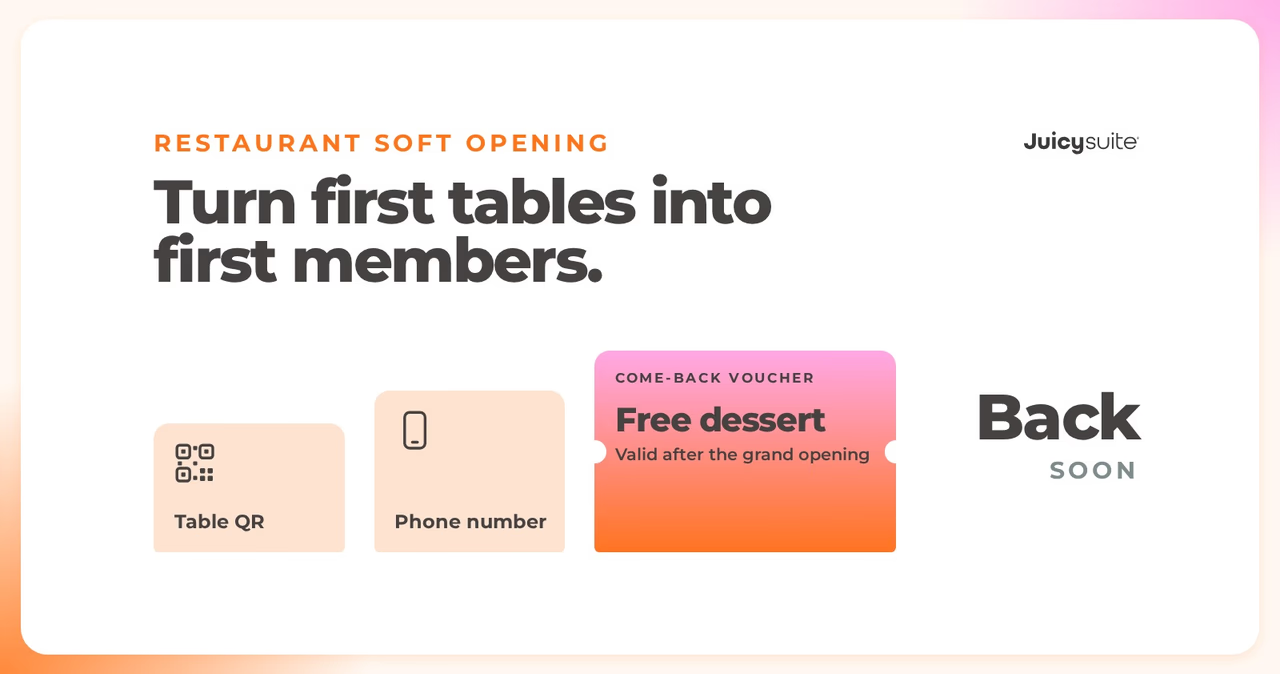
Put a QR code where guests already look: a table card, the menu or the counter, with one line on what members get. Don't make anyone download an app.
-
Ask for a phone number first. Make other fields optional, and only add one if you'll use it.
-
Give staff a short script. For example: "We're opening officially soon. If you join our members' list, you'll get a welcome offer for your next visit after we open." Then let the guest decide.
-
Time the ask. While guests wait for the bill is a natural minute.
-
Know who joined during the soft opening, by sign-up date or a dedicated link, so you can find these guests later.
In JuicySuite: the Membership Website has "no app to download". It generates "a branded URL and QR code for your member site", and a shopper "enters a phone number or signs in with social". The form has "custom fields you control", and the profile "lands in your CRM, ready to segment". Members get "a secure Apple Wallet or Google Wallet pass — or a web pass".
Consent and privacy when you collect contact details
In Hong Kong, the Personal Data (Privacy) Ordinance (PDPO) applies. Show a Personal Information Collection Statement (PICS) at or before the point of collection, saying why you're collecting the data, who it may be shared with, and how guests can access or correct it. Collect only what you need: a phone number and a name is usually enough to start. If you want to send promotional messages, ask for the guest's consent to direct marketing as a separate, clear choice, not a pre-ticked box, and make opting out easy. Our PDPO compliance guide for CRM covers the principles in more detail. Other markets have their own privacy and messaging rules, so check the ones that apply where you operate. This is a starting point, not legal advice.
A welcome reward that brings guests back after launch
The real test is whether a soft-opening guest comes back once you're properly open. Give them a reason that only works after launch:
-
A come-back voucher with a short window, such as a free dessert or drink valid in the first weeks after the grand opening. A clear expiry gives guests a reason to return soon.
-
Conditions you can afford. A minimum spend or a specific item usually costs less than a percentage off the bill.
-
A first-month stamp card, with a reward a few visits away, to turn a preview into a habit.
In JuicySuite: Welcome rewards are set up under "Loyalty Program - Essentials", where you "add the desired rewards and specify the quantity" and can "include conditions and notifications". Welcome gifts are part of the Growth plan and above on the pricing page. Digital Voucher supports "percentage off, fixed amount, buy-one-get-one, free item, or gift", with "minimum spend, eligible SKUs, stacking limits, and expiry", and the voucher "declines itself at the till" when conditions aren't met. The Digital Stamp Card lives in Apple Wallet and Google Wallet. When the last stamp lands, JuicySuite "drops a reward voucher straight into the customer's wallet". With the NFC Stamp, "your staff press it against the customer's phone, and the stamp lands on the digital stamp card they already carry".
Group soft-opening guests so you can thank them
Soft-opening guests came early, saw you at your least polished, and joined anyway. Treat them as their own group:
-
Invite them to the grand opening first, before the public announcement.
-
Thank them, and say what you changed because of their feedback.
-
Watch whether they come back. One gentle reminder before the welcome voucher expires is reasonable; more starts to feel like pressure.
In JuicySuite: Customer Segmentation builds "dynamic segments" that update "as behaviour changes", mixing "spend, frequency, products, tier, location, channel, and lifecycle stage". You can "push any segment straight into a campaign, voucher, or automation — to email, SMS, wallet, ads, or POS — in one click". For messages, our SMS marketing guide for restaurants covers consent, timing and opt-outs.
Collect feedback while it's fresh
Keep feedback separate from sign-up, so joining never feels like the price of giving an opinion:
-
Ask a few specific questions: the best dish, what you'd change, and whether anything was slow.
-
Talk to tables. A manager at the table hears things a form won't.
-
Debrief after each session, so comments become fixes before the next service.
A paper card or a short online form both work.
Use the soft-opening list to fill your restaurant grand opening
The grand opening shouldn't rely on walk-ins alone. Your soft-opening members already know the food and the team:
-
Send them the date first, with their welcome offer as a reminder.
-
Ask them to bring someone. A guest who enjoyed the preview is a credible recommendation.
-
Make the invitation personal, with a members' first hour or a reserved table.
-
Keep sign-up visible on the day. The same QR code keeps working.
If you're still working out how to open a restaurant, fit-out, hiring and suppliers come first. Member capture is just the part that's easy to leave too late.
What to measure in the first 30–60 days
Compare your own numbers across sessions and weeks; you don't need a benchmark:
-
Soft-opening sign-ups: how many guests joined, per session.
-
Sign-up share: members joined divided by guests served, to see whether the script or QR placement needs work.
-
Return visits: how many soft-opening members came back in the first 30 and 60 days after the grand opening.
-
Welcome voucher redemption: how many come-back vouchers were used before they expired.
-
Stamp card progress: first-month cards started and completed.
-
Opt-outs: rising unsubscribes mean your messages need work.
In JuicySuite: the Membership Website includes a "live KPI dashboard by store and cohort". Digital Voucher tracks "issuance, redemption, and breakage by campaign in real time". The Digital Stamp Card reports "active cards, stamps collected, rewards redeemed — by store, by hour, by customer".
Restaurant soft opening checklist
-
Grand opening date set; soft-opening sessions planned with time to fix things
-
Invite list built: friends and family, neighbors, nearby offices, local community
-
Limited menu and hours; pricing (paid, discounted or free) told to guests
-
Sign-up live: QR on tables and counter, phone number first, minimal fields
-
PICS shown at sign-up; separate direct-marketing consent; easy opt-out
-
Come-back voucher valid in the weeks after the grand opening; first-month stamp card ready
-
Staff briefed on the sign-up script and the feedback questions
-
A way to find soft-opening members later (by sign-up date or a dedicated link)
-
Debriefs scheduled; grand opening invitation drafted for soft-opening members
-
Metrics review at 30 and 60 days
Related reading
Next steps: our cafe loyalty program guide, CRM for restaurants in Hong Kong, the membership system buying guide, and our food and beverage page.
Start with the first table
Opening with a member list takes a QR code on the table, a short script, a reason to come back, and a plan for the people who said yes. To see how a no-app sign-up could work in your restaurant, the Membership Website page explains it, and a walkthrough is there if it helps.
FAQ
What is a soft opening? A limited, low-key launch before a business opens officially. A restaurant usually opens to a small or invited group with a shorter menu and hours, to test the kitchen and service and fix problems early.
What's the difference between a soft opening and a grand opening? A soft opening is quiet and limited, mainly for practice and feedback. A grand opening is the public, promoted launch. Soft-opening guests are a natural first audience for the grand opening.
Who should I invite to a restaurant soft opening? Start with friends and family, then add neighbors, nearby offices and shops, and local community contacts.
Should a restaurant soft opening be free? It's your choice: full price, a discount or a free tasting. Decide in advance and tell guests before they arrive.
How do I collect guests' contact details at a soft opening? Put a QR code on the table or counter that links to a sign-up page, ask for a phone number first, and keep other fields optional. In Hong Kong, show a Personal Information Collection Statement at or before collection, and ask separately for consent before sending direct marketing.